Why You Should Read Hermann Hesse: His Best Works

Disclaimer
This post may contain affiliate links. I will make a small commission if you make a purchase through one of these links, at no extra cost to you. See full disclosure and disclaimer policy HERE.
Have you ever read a book that felt less like a story and more like a quiet conversation with yourself? The kind that doesn’t shout answers but gently rearranges the questions in your mind? That’s Hermann Hesse in a nutshell. Reading Hesse isn’t about plot twists or dramatic cliffhangers. It’s about inner earthquakes—subtle, slow, and life-altering.
If you’ve ever felt out of sync with the world, suspicious of social norms, or quietly obsessed with meaning, identity, and self-discovery, Hesse might feel uncomfortably… accurate. Let’s talk about why reading Hermann Hesse is not just worthwhile, but strangely necessary in a world that rarely slows down.
Table of Contents
Who Was Hermann Hesse?
Hermann Hesse was a German-Swiss writer, poet, and painter best known for exploring the inner life of the individual—especially the tension between society and the self.
Born on July 2, 1877, in Calw, Germany, Hesse grew up in a strict, religious household that expected him to become a theologian. He rebelled early, dramatically and repeatedly, which set the tone for both his life and his literature.
From a young age, Hesse struggled with depression, identity crises, and a deep resistance to authority. These weren’t just biographical footnotes—they became the emotional engine of his writing. Many of his novels read like thinly veiled autobiographies of spiritual rebellion.
Hesse’s youth was turbulent. He ran away from school, attempted suicide as a teenager, and spent time in institutions. These experiences gave him an intimate understanding of alienation and psychological pain long before he ever wrote about them.
As an adult, his life didn’t magically stabilise. His first marriage collapsed, his son became seriously ill, and World War I shattered his faith in nationalism and European culture. During this period, Hesse underwent Jungian psychoanalysis, which profoundly influenced his work.
In 1946, he was awarded the Nobel Prize in Literature for his “inspired writings which, while growing in boldness and penetration, exemplify the classical humanitarian ideals and high qualities of style.”
Hesse died in 1962 in Switzerland, but his work continues to resonate with readers who feel restless, conflicted, or spiritually curious. He didn’t offer answers so much as permission—to question, to wander, to become.
In short, Hermann Hesse was a writer for people who feel like they don’t quite belong—and are brave enough to search for their own path anyway.
He Writes for the Restless Soul
Hesse doesn’t write for people who have everything figured out. He writes for wanderers, doubters, and overthinkers. His protagonists are almost always in motion—not geographically, but spiritually. They’re searching, questioning, shedding old skins like snakes that got tired of being who they were.
Think of Hesse as a literary mirror. You don’t read his books to escape yourself—you read them to confront yourself. His characters wrestle with identity, alienation, and the tension between society and individuality. Sound familiar? Exactly.
His Books Feel Like Philosophical Road Trips
Reading Hermann Hesse is like taking a long drive with a philosopher who occasionally goes quiet just to let you think. He blends Eastern philosophy, Western psychology, mysticism, and existential questioning into narratives that feel deceptively simple but endlessly deep.
Siddhartha, for example, isn’t just a spiritual novel—it’s a meditation on experience versus knowledge. Demian explores the duality of good and evil without moral hand-holding. And The Glass Bead Game? That’s Hesse at his most ambitious, building an entire intellectual universe and asking whether pure intellect can ever replace lived experience.
These books don’t spoon-feed wisdom. They invite you to walk alongside it.
He Makes You Comfortable With Not Knowing
Most modern life is about answers. Fast answers. Confident answers. Hesse goes in the opposite direction. He lingers in uncertainty and treats doubt not as a flaw, but as a necessary stage of growth.
Reading Hesse feels like being told, “It’s okay to be unfinished.” His work embraces contradictions, inner conflict, and the idea that becoming yourself is a lifelong, messy process. In a world obsessed with self-optimisation, that’s refreshingly human.
His Language Is Simple—but Don’t Be Fooled
Hesse’s prose is clean, almost modest. No verbal gymnastics. No unnecessary ornamentation. And that’s precisely what makes it powerful. He writes like someone who trusts silence as much as words.
The simplicity draws you in, but the ideas linger long after you’ve closed the book. It’s like drinking clear water that somehow changes your chemistry. You may not notice it immediately, but something shifts.
Most Notable Works
Hesse’s books revolve around self-discovery, duality, spirituality, and individuality. He was deeply influenced by Eastern philosophies, particularly Buddhism and Hinduism, which he encountered through his parents’ missionary background in India. Some of his most famous works include:
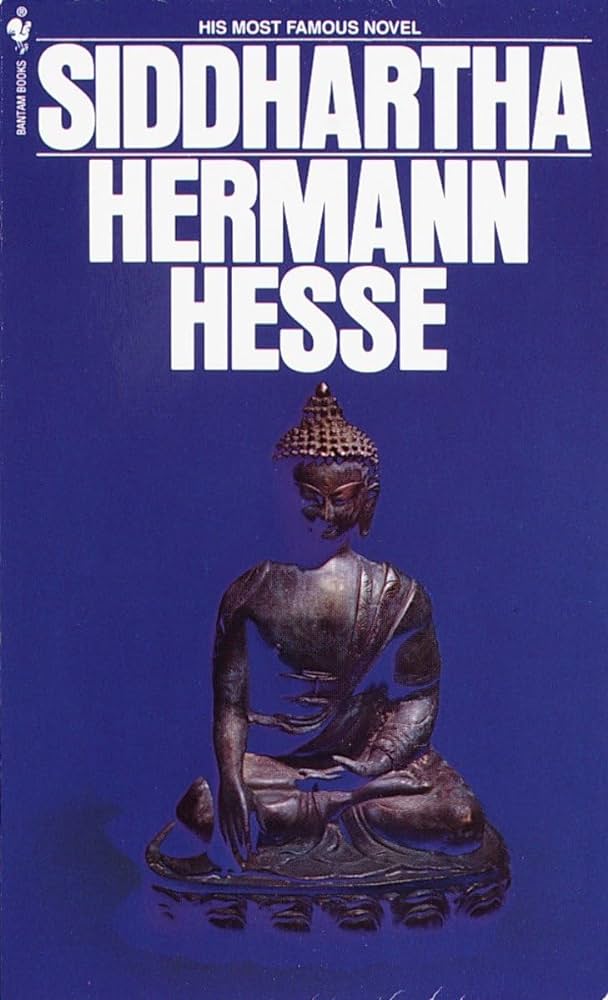
Siddhartha (1922)
Probably Hesse’s most famous novel—and for good reason. Siddhartha follows a man’s spiritual journey towards enlightenment, not through doctrine or teachers, but through direct experience. It draws heavily on Eastern philosophy, especially Buddhism and Hinduism, yet remains deeply personal rather than religious. Think of it as a reminder that wisdom can’t be borrowed—you have to live it.
Demian (1919)
This is Hesse’s awakening novel. Written after World War I and influenced by Jungian psychology, Demian explores duality, self-discovery, and breaking away from moral absolutes. Light versus dark, conformity versus authenticity—it’s all here. This book tends to resonate deeply with young adults and anyone questioning the values they were raised with.

Steppenwolf (1927)
Dark, intense, and brutally honest, Steppenwolf is Hesse at his most psychologically raw. The novel centres on alienation, depression, and the fractured modern self. It’s not an easy read emotionally, but it’s unforgettable. If Siddhartha is calm and flowing, Steppenwolf is jagged glass—and intentionally so.

The Glass Bead Game (1943)
Hesse’s most ambitious and intellectually dense work. Set in a fictional scholarly society, the novel questions the value of pure intellect detached from real life. It’s a meditation on culture, education, and the danger of intellectual isolation. This novel earned Hesse the Nobel Prize in Literature and is often considered his magnum opus.

Narcissus and Goldmund (1930)
A beautifully written exploration of two opposing life paths: the intellectual and the sensual, the disciplined and the artistic. Through the friendship of two very different men, Hesse examines the tension between mind and body, reason and instinct. It’s philosophical, emotional, and quietly tragic.

Peter Camenzind (1904)
Hesse’s first major success and an early glimpse into his lifelong themes. This novel focuses on nature, solitude, and the conflict between society and the individual. Less complex than his later works, but essential for understanding his evolution as a writer.

Knulp (1915)
A short, melancholic novel about a wandering outsider who refuses conventional life. It’s simple, poetic, and deeply sympathetic to those who live on the margins by choice—or necessity.

His Themes Are Timeless (and Weirdly Modern)
Despite being written in the early 20th century, Hesse’s themes feel eerily current. Burnout, alienation, identity crises, the pressure to conform, the hunger for meaning—this is modern anxiety in literary form.
If you’ve ever questioned success, rejected conventional life paths, or felt torn between individuality and belonging, Hermann Hesse is speaking your language. He was asking these questions long before social media, productivity culture, and algorithmic living made them louder.

Conclusion
Reading Hermann Hesse is less about entertainment and more about initiation. His books don’t tell you who to be—they challenge you to find out for yourself. They sit with you in uncertainty, validate your inner conflicts, and remind you that growth often feels like discomfort before it feels like clarity.
If you’re looking for literature that doesn’t just pass time but changes how you think, feel, and question the world, Hermann Hesse is a door worth opening. Just don’t expect to walk out the same person.
FAQs
Did you like it? Pin this post for later!


You May Also Like