Disclaimer
This post may contain affiliate links. I will make a small commission if you make a purchase through one of these links, at no extra cost to you. See full disclosure and disclaimer policy HERE.

What would you do if you met someone who looked exactly like you?
Not vaguely similar. Not the sort of resemblance that makes strangers ask whether you’re related. Imagine encountering another person with your face, your height, your voice—someone who could, quite literally, step into your life.
And what if they did?
That deliciously unsettling premise lies at the heart of The Scapegoat by Daphne du Maurier, a psychological novel first published in 1957. Although perhaps less famous today than Rebecca or My Cousin Rachel, it contains many of the qualities that make du Maurier such an irresistible writer: doubles, deception, isolation, morally ambiguous characters, sinister houses, secrets, and the persistent feeling that reality is not quite as stable as it appears. But The Scapegoat is more than an identity-swap story.
Beneath its almost fantastical premise lies a surprisingly thoughtful exploration of loneliness, responsibility, family, guilt, and the uncomfortable question of whether becoming someone else might actually reveal who you are.
What Is The Scapegoat About?
The novel begins with John, a lonely English academic travelling through France. He is deeply interested in French history and culture, yet despite this connection to the country, he feels detached from life itself.
John is an observer rather than a participant. Then something extraordinary happens.
He encounters Jean de Gué, a French aristocrat who looks almost exactly like him. The resemblance is so extraordinary that the two men could practically be twins. Their personalities, however, are another matter entirely.
Jean is charismatic, complicated, manipulative, and deeply entangled in the lives of his family. John, by contrast, has few meaningful attachments and seems to drift through existence without truly belonging anywhere.
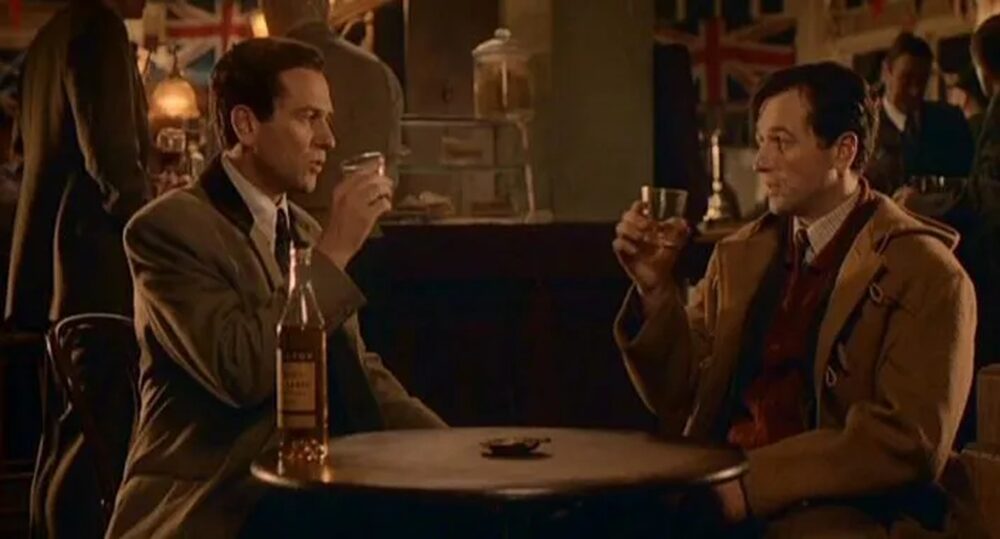
The two men spend an evening drinking together.
When John wakes the following morning, Jean has disappeared—and taken John’s clothes and possessions with him. John is then mistaken for Jean.
Instead of immediately exposing the misunderstanding, he allows himself to be carried into Jean’s life.
And that is where the real story begins.
John finds himself transported to Jean’s family estate, where he must navigate relationships he knows nothing about, secrets nobody has told him, financial difficulties he does not understand, and people who all believe they know him intimately.
Suddenly, the man who belonged nowhere belongs to everyone.
Unfortunately, everyone seems to have a different reason for resenting him.

Two Men, One Face
The doppelgänger is one of literature’s most fascinating devices. Why?
Because another version of ourselves is inherently disturbing.
A mirror is harmless because we control it. It moves when we move. It stops when we stop. But imagine your reflection stepping away from the glass and beginning to make decisions of its own.
That is essentially what du Maurier gives us in The Scapegoat.
John and Jean may look identical, but their lives represent almost opposite possibilities.
John has freedom but little connection. Jean has connections everywhere but appears desperate to escape them.
John initially envies what Jean possesses: family, history, property, relationships, responsibility. Jean, meanwhile, seems eager to abandon precisely those things.
The irony is beautifully constructed.
Each man possesses something the other lacks. Yet du Maurier gradually complicates the idea that one life is better than the other.
A life is not a coat you can simply put on. It comes with stains.
RELATED:
John Is an Unusual Protagonist
John is fascinating precisely because he isn’t particularly heroic when the novel begins.
He is lonely, passive, introspective, and emotionally disconnected. He seems to have spent much of his life standing slightly outside the world, studying it rather than participating in it.
His decision to impersonate Jean is therefore strange but psychologically believable.
For perhaps the first time, people need something from him. They expect things. They accuse him of things. They love him, dislike him, fear him, depend upon him.
It’s overwhelming—but it also gives John something he has lacked: significance.
His impersonation gradually becomes more than deception. It becomes an experiment in living.
And the deeper he moves into Jean’s existence, the more he begins trying to repair it.
This is where The Scapegoat becomes particularly interesting. John doesn’t merely pretend to be Jean. He begins asking, consciously or otherwise, what Jean should have been.
A Family Built on Secrets
Jean’s family provides much of the novel’s psychological tension.
The château John enters is not exactly a warm family home. It is more like an emotional minefield.
Everyone has history with Jean, but John doesn’t know what that history is. Every conversation therefore becomes a puzzle. A casual remark might contain years of resentment. A gesture might carry an intimacy John cannot understand. Someone may refer to an event that he knows absolutely nothing about.
John—and therefore the reader—must constantly interpret clues.
This creates one of the novel’s greatest pleasures. We learn about Jean backwards.
Instead of meeting a character and watching his relationships develop, we meet the consequences of relationships that have already happened.
John is essentially conducting an archaeological excavation of another man’s personality.
Every conversation uncovers another fragment. And not all of those fragments are pleasant.
The Château Is Almost a Character
Anyone familiar with Daphne du Maurier knows how effectively she uses houses.
Manderley dominates Rebecca. Menabilly inspired some of the landscapes and houses that haunt her fiction. Buildings in du Maurier’s novels rarely function as simple scenery. They absorb memory.
The château in The Scapegoat works in a similar way.
It represents history, inheritance, obligation, and decline. John does not merely inherit Jean’s identity; he inherits a physical world shaped by generations before him.
There is something distinctly Gothic about this.
The house contains people trapped by old relationships, old resentments, old expectations, and economic realities that cannot simply be wished away.
John arrives almost like a ghost inhabiting another man’s body.
Yet ironically, this impostor may become more invested in preserving the family than the man whose identity he has stolen.
Identity Is the Real Mystery
On the surface, The Scapegoat asks whether John can successfully impersonate Jean.
But the deeper question is far more interesting: What actually makes someone who they are?
Is identity our face? Our memories? Our relationships? Our responsibilities? Our choices?
John possesses Jean’s appearance but none of his history. Yet once he begins behaving differently, the relationships around “Jean” begin changing.
This suggests something fascinating.
Perhaps identity is not entirely fixed. Perhaps part of who we are exists in the patterns we repeatedly create with other people.
Change the pattern and you may change the person—or at least the version of that person experienced by everyone else.
John cannot rewrite Jean’s past. But he can behave differently in the present.
And those differences ripple outward.
The Meaning Behind the Title
The title The Scapegoat becomes increasingly important as the novel progresses.
Traditionally, a scapegoat is someone who carries blame that properly belongs elsewhere. The concept has ancient ritual origins, but psychologically it describes something extremely familiar: families and communities often concentrate their frustrations onto one person.
Jean occupies an intriguing position within his family.
He has caused genuine damage, yet he also becomes a convenient focal point for wider dysfunction.
When John takes his place, he inherits not merely Jean’s clothes, home, and relationships.
He inherits his blame.
This gives the identity exchange an almost ritualistic quality.
John takes upon himself another man’s sins. But unlike Jean, he tries to do something with the burden.
The question is whether redemption can ever be achieved on somebody else’s behalf.
John and Jean as Opposing Selves
There is also something almost Jungian about the relationship between the two men.
Jean can be interpreted as John’s shadow: charismatic where John is withdrawn, reckless where John is cautious, sensual where John is restrained, selfish where John attempts to be conscientious.
Yet the opposition isn’t perfectly clean. That matters.
Du Maurier avoids turning the novel into a simplistic battle between good John and evil Jean.
Instead, the men seem like distorted possibilities of one another.
John discovers capacities within himself that his previous life never required. Jean’s identity gives him permission—or perhaps forces him—to become more decisive, emotionally involved, and courageous.
In that sense, the impersonation paradoxically makes John more authentic.
He becomes more himself while pretending to be someone else.
Post-War France Adds Another Layer
The French setting is more than picturesque scenery.
The novel takes place in a country still living with the consequences of the Second World War. Memories of occupation, collaboration, resistance, economic disruption, and changing social structures remain close beneath the surface.
Jean’s aristocratic family belongs to an older order struggling to maintain itself.
The glassworks associated with the estate adds another dimension. The family’s survival is not merely emotional or symbolic; livelihoods depend upon decisions made within the household.
That gives John’s impersonation genuine consequences.
He isn’t playing a private game. His decisions affect other people.
The château, the family, and the business all exist within a France negotiating the uncomfortable relationship between past and future.
John enters this world as an outsider, yet he quickly becomes responsible for its survival.
Du Maurier’s Talent for Moral Ambiguity
One reason Daphne du Maurier remains so readable is that she rarely tells us exactly what to think about her characters.
People are allowed to be contradictory.
Victims can be manipulative. Cruel people can be vulnerable.
Good intentions can produce terrible consequences.
John himself raises difficult ethical questions. After all, however sympathetic he becomes, he is deceiving an entire family.
We may understand why he initially goes along with the mistake, but eventually it stops being a misunderstanding. He chooses the deception. Yet as he becomes more involved in the family’s problems, the moral equation becomes increasingly strange.
What happens when an impostor behaves more responsibly than the genuine person?
Who deserves the life then?
Du Maurier refuses to provide easy answers.
Is The Scapegoat a Gothic Novel?
Not exactly—but Gothic readers will probably feel very much at home.
There are no supernatural monsters lurking through the corridors. The horror is psychological.
You have an isolated château. A mysterious double. Family secrets. Death. Inherited guilt.
A protagonist trapped inside an identity that isn’t his. A constant sense that something terrible might happen.
These ingredients create an atmosphere that sits comfortably alongside du Maurier’s darker fiction.
The uncanny element is particularly strong because John himself becomes something ghostlike: a man occupying another man’s place while the original remains somewhere beyond reach.
It’s Gothic fiction stripped of the supernatural and rebuilt around identity.
The Suspense Is Quiet but Effective
Readers expecting a modern thriller may find the pacing relatively slow.
That isn’t necessarily a weakness. Du Maurier’s suspense works like a tightening knot rather than an explosion.
John must constantly worry about being discovered. Every person he meets knows Jean better than he does. A single incorrect memory could expose everything.
Even ordinary conversations become dangerous. Someone asks a question. John hesitates. Do they notice? Someone mentions yesterday. John doesn’t know what happened yesterday. Someone expects affection. Should he give it?
This is psychological suspense at its simplest and most effective. Du Maurier turns social interaction into interrogation without needing detectives or police.

Book Review: The Mysteries of Udolpho by Ann Radcliffe

Book Review: The Golden Bowl by Henry James

Book Review: The Scapegoat by Daphne du Maurier
The Scapegoat Is Also About Belonging
Perhaps the most moving theme in the novel is belonging.
At the beginning, John appears free. But freedom without attachment has left him strangely empty.
Jean’s life is the opposite. It is crowded with obligations.
John initially experiences these responsibilities almost as an adventure, but gradually they give him something deeper: purpose. People depend upon him. His actions matter. His presence changes things. The irony is painful.
John finally discovers somewhere he wants to belong—and it belongs to someone else.
That tension gives the novel much of its emotional power.
What Makes The Scapegoat Different From Rebecca?
Readers approaching The Scapegoat because they loved Rebecca should expect something different.
Both novels explore identity, psychological manipulation, imposing houses, and characters living beneath the weight of another person’s presence. But the dynamics are reversed.
In Rebecca, the unnamed narrator struggles against the overwhelming presence of an absent woman.
In The Scapegoat, John deliberately inhabits the identity of an absent man.
One character fears being erased. The other voluntarily erases himself.
Yet both novels ask a similar question: how much of our identity depends upon how others see us?
That thematic connection makes The Scapegoat especially rewarding for readers already familiar with du Maurier’s work.
What I Loved About The Scapegoat
The premise alone is irresistible, but the psychological consequences make the novel memorable.
Du Maurier could easily have turned the story into a conventional thriller about whether John gets caught.
Instead, she asks what happens when pretending becomes preferable to reality.
The gradual transformation of John is particularly compelling. His impersonation begins almost passively, but eventually he develops genuine emotional investment in the people around him.
There’s also something wonderfully uncomfortable about watching him discover Jean through other people’s reactions.
Imagine entering a room and discovering that someone hates you. You don’t know why. Then someone else loves you. You don’t know why either. That’s essentially John’s existence. It makes every relationship mysterious.
What Some Readers May Not Love
The unusual premise requires a certain willingness to suspend disbelief.
Two unrelated men who look sufficiently identical to fool close relatives is obviously improbable.
But focusing too heavily on realism misses the point.
The doppelgänger functions almost like a fairy-tale device. Du Maurier asks us to accept one extraordinary circumstance so she can explore very ordinary human questions.
The pacing may also feel slower to readers accustomed to contemporary psychological thrillers. Much of the tension comes from conversations, relationships, and John’s internal reactions rather than constant dramatic twists.
But give the story room to breathe. Its power accumulates gradually.
Who Should Read The Scapegoat?
This book is particularly suited to readers who enjoy psychological fiction, Gothic atmosphere, morally complicated characters, family secrets, identity stories, and novels in which setting plays an important role.
Naturally, Daphne du Maurier fans should read it.
But I’d also recommend it to readers fascinated by doppelgänger stories or books exploring the unstable boundary between performance and identity.
If you’ve ever wondered whether you could live differently if nobody knew who you used to be, The Scapegoat takes that fantasy and follows it somewhere much darker.

Conclusion
The Scapegoat deserves far more attention than it receives.
Its central premise may sound almost playful—two identical strangers exchange lives—but Daphne du Maurier turns it into something psychologically complex and increasingly haunting.
At its heart, this isn’t really a novel about looking like somebody else.
It’s about responsibility.
John begins as a man with almost nothing tying him to the world. By becoming Jean, he inherits burdens, mistakes, relationships, and obligations. Strangely, those burdens begin to give his life meaning.
And perhaps that is the novel’s most interesting paradox.
John finds himself by losing himself. He discovers belonging inside a stolen identity.
Du Maurier takes the fantasy of escaping your life and turns it upside down. Maybe the problem isn’t that we cannot escape ourselves.
Maybe it’s that we only discover ourselves when something finally demands that we become someone.
FAQs
Did you like it? Pin this post for later!